
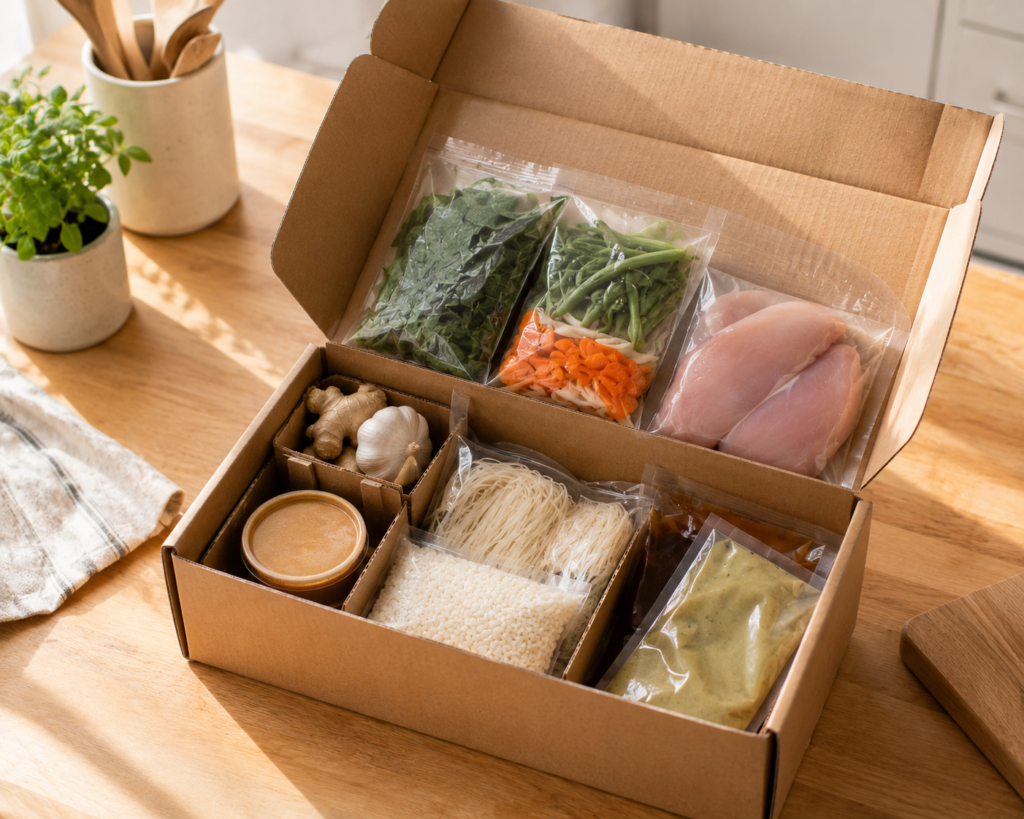
Quick Answer
Are meal kits worth it purely on cost? Generally, no — HelloFresh and similar services run $10.99 to $12.49 per serving before shipping (which adds roughly $2–3 more per serving on smaller plans), while cooking the same style of meal from scratch typically costs $4 to $10 per serving, based on multiple independent 2026 cost breakdowns. That said, meal kits consistently beat takeout and restaurant meals, which commonly run $18–$40+ per serving — so the real question isn’t “meal kit vs. scratch cooking” in isolation, it’s what a meal kit is actually replacing in your week.
Nearly every recipe already on this site falls well within, or below, the low end of that scratch-cooking range — the budget dinner ideas guide’s recipes average $1–$3 per serving, meaning the gap between this site’s approach and a meal kit subscription is even larger than the general scratch-cooking comparison suggests.
The Real Cost Comparison
| Cost Per Serving | Monthly Cost (2 people, 3 dinners/week) | |
|---|---|---|
| HelloFresh (typical) | $10.99–$12.49 + shipping | ~$307–$332 |
| Premium meal kits (Factor, etc.) | $13–$16+ | ~$340–$420+ |
| Cooking from scratch (general) | $4–$10 | ~$110–$275 |
| This site’s budget recipes | $1–$3 | ~$28–$83 |
| Takeout/restaurant delivery | $18–$40+ | ~$500–$1,100+ |
The pattern holds consistently across every independent cost breakdown available: meal kits sit in the middle, cheaper than eating out but meaningfully more expensive than cooking the same meals yourself.

What You’re Actually Paying the Extra $6–$9 Per Serving For
The premium isn’t a scam or pure markup — it buys three specific things:
- Zero meal planning. No deciding what to cook, no scrolling recipes — this is the single biggest time-saver for people already replicating it via meal prep on a budget systems.
- Pre-portioned ingredients. No half-used bags of specialty ingredients left over, which reduces one specific type of food waste (though not others — see below).
- Reduced grocery shopping trips. The convenience of ingredients arriving at your door, skipping the budget grocery shopping trip entirely for those specific meals.
- For an independent third-party breakdown, see NerdWallet’s HelloFresh cost analysis.
For someone who would otherwise default to takeout on busy nights, a meal kit genuinely can save money compared to that specific alternative — the comparison that matters isn’t scratch cooking in a vacuum, it’s realistically weighing what a meal kit replaces in your actual week.
Where Meal Kits Make the Least Financial Sense
- Single-person households. Most services require ordering 2-person minimums, leading to either leftovers or waste — solo diners consistently get the worst per-serving value from these services.
- Households already comfortable meal planning. If grocery shopping and recipe selection aren’t a genuine time barrier, the entire premium is paying for a problem you don’t have.
- Anyone who could otherwise use this site’s budget recipes. Since recipes like the ground beef recipes, chicken thigh recipes, and egg dinner recipes already covered here run $1–$3 per serving with similarly simple instructions, a meal kit’s main advantage (simplicity) is significantly reduced.
Where Meal Kits Can Genuinely Make Sense
- Replacing takeout, not scratch cooking. If the realistic alternative on a busy night is a $25 delivery order, an $11–13 meal kit serving is a genuine improvement.
- Learning new techniques or recipes. The recipe cards that come with meal kits can build cooking confidence that transfers to cheaper scratch cooking later.
- Extremely time-constrained households where the alternative to a meal kit isn’t cooking from scratch at all, but skipping a home-cooked meal entirely.
Expert Tip
If cost is the primary concern, using a meal kit’s recipe cards once, then recreating the same recipe from scratch on future weeks using budget grocery shopping principles, captures most of the “learning new recipes” benefit without paying the ongoing premium — several reviewers who’ve directly compared the two approaches report exactly this pattern once they’ve built a small recipe library this way.
Common Meal Kit Cost Mistakes to Avoid
- Comparing only the promotional first-week price. Most services offer 40–60% off the first box; multiplying that discounted price by weeks-per-month dramatically understates the real ongoing cost.
- Forgetting shipping is a flat fee, not per-serving. A smaller 2-meal plan absorbs the ~$10–11 shipping charge across fewer servings, making the effective per-serving cost noticeably higher than the advertised price.
- Not accounting for what still needs to be bought separately. Snacks, breakfast, lunch, and any meals beyond the subscription’s dinner count still require a separate grocery trip, which is easy to forget when budgeting.
- Assuming all meal kits cost the same. As the comparison table shows, premium and fully-prepared services can run considerably more per serving than a standard mid-range kit.
Frequently Asked Questions
Is HelloFresh actually cheaper than buying groceries yourself? No, according to nearly every independent 2026 cost analysis — a typical home-cooked dinner for two costs roughly $6–10 in groceries, while the equivalent HelloFresh meal runs $11–13 per serving after shipping.
Are meal kits cheaper than takeout? Yes, consistently — meal kits at $11–16 per serving are meaningfully cheaper than typical takeout or restaurant delivery at $18–40+ per serving, which is the more realistic comparison for households that would otherwise order out.
Is there a meal kit option that’s actually budget-friendly? Ordering the maximum number of meals per week (typically 4–6) dilutes the flat shipping fee across more servings, meaningfully improving the per-serving cost compared to a 2-meal minimum plan — though it still won’t match scratch-cooking costs.
Do meal kits actually reduce food waste? Partially — pre-portioned ingredients reduce the specific waste of unused partial ingredients, but packaging waste from individually wrapped components is a common criticism, so the net waste impact depends on what you’re comparing it to.
What’s the real breakeven point for a meal kit subscription? If a meal kit genuinely replaces a takeout order you would have otherwise made, it likely saves money. If it replaces a meal you would have cooked from scratch anyway — especially using budget-focused recipes like the ones on this site — it almost always costs more.

Final Thought
Are meal kits worth it? The honest answer depends entirely on the realistic alternative, not on comparing the sticker price to an idealized scratch-cooking budget. For anyone already following the budget dinner ideas, meal prep, and budget grocery shopping approaches already on this site, the gap between a $1–3 scratch-cooked meal and an $11–13 meal kit serving is simply too large for the convenience to pencil out — but for someone whose real alternative is regular takeout, that same math tells a genuinely different story.
