
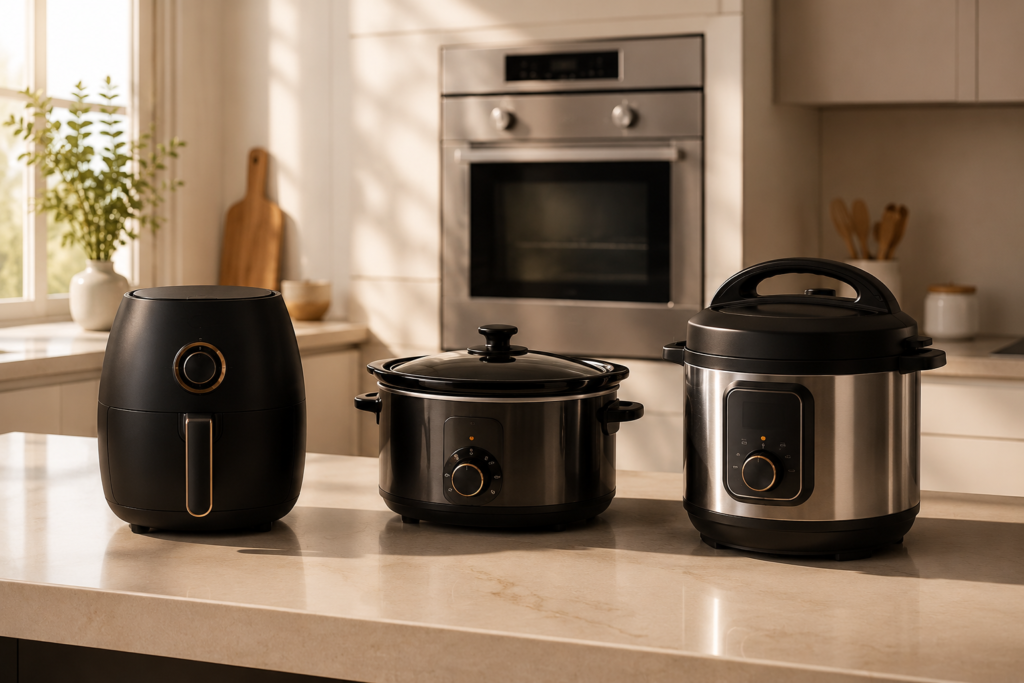
Featured Snippet Answer
At the current U.S. average of about 18.4 cents per kilowatt-hour, an hour in an electric oven costs roughly 28 to 44 cents, an air fryer meal about 9 cents, a slow cooker about 22 cents for eight hours, and a microwave about 3 cents. Swapping one oven meal a day for an air fryer saves close to $95 a year.
Quick Answer
The cost to run kitchen appliances in the U.S. looks very different from what most online guides show. Most advice about “energy-efficient cooking” is written for British kitchens — priced in pence, built around the UK energy price cap. American numbers look different, and they’ve been moving fast. The U.S. average residential electricity rate reached roughly 18.4 cents per kilowatt-hour in 2026, up about 25% since 2022, which adds somewhere near $400 a year to a typical household bill before you cook a single meal.
The good news is that cooking is a small slice of that bill, and the fixes are almost free. You don’t need a new appliance. You mostly need to know which of the machines already sitting on your counter is the cheap one for the job in front of you. This guide runs the actual math on eight of them, using the U.S. Department of Energy’s own formula, so you can see where the pennies go — and where the savings are too small to bother chasing.
Key Takeaways
- The oven is the expensive one, and preheating is why. Those 12 to 15 minutes at full power cook nothing at all.
- An air fryer meal costs roughly a nickel to a dime in electricity — the cheapest real cooking method for one to three people. New to one? Start with our air fryer guide for beginners.
- A slow cooker running eight hours costs less than 30 minutes of oven time. Low wattage beats short runtime almost every time. See our slow cooker recipes for beginners.
- An electric pressure cooker lands in the same range as a slow cooker — the difference between them is pennies, not dollars. Our Instant Pot frozen meat guide covers the bigger win: skipping thaw time.
- Brewing coffee at home costs under 5 cents in electricity. The beans are the expense, not the machine — the full math is in our coffee at home vs. coffee shop breakdown.
- Your electricity rate matters more than your appliance choice. A Hawaii household pays roughly triple what an Idaho household pays for the exact same meal.
The Real Cost to Run Kitchen Appliances in 2026
Here is the real cost to run kitchen appliances, appliance by appliance. All figures below use the U.S. average rate of $0.184 per kWh and the Department of Energy’s standard formula: wattage × hours used ÷ 1,000 = kilowatt-hours, then multiply by your rate. Wattages are typical mid-range models. Your appliance’s real draw is stamped on its nameplate — usually on the bottom or the back. Source: U.S. Department of Energy appliance energy formula
| Appliance | Typical wattage | Realistic session | Energy used | Cost per use |
|---|---|---|---|---|
| Electric oven | 2,400 W (cycles on/off) | 1 hour incl. preheat | 1.5–2.4 kWh | 28¢–44¢ |
| Electric stovetop burner | 1,500 W (large burner) | 30 minutes | 0.75 kWh | 14¢ |
| Slow cooker (low) | 150 W | 8 hours | 1.2 kWh | 22¢ |
| Electric pressure cooker | 1,000 W (cycles) | 90-minute meal | 0.6–0.9 kWh | 11¢–17¢ |
| Air fryer | 1,500 W (cycles) | 20 minutes | 0.4–0.5 kWh | 7¢–9¢ |
| Toaster oven | 1,200 W | 20 minutes | 0.4 kWh | 7¢ |
| Drip coffee maker | 900 W | 10-minute brew | 0.15 kWh | 3¢ |
| Microwave | 1,100 W | 10 minutes | 0.18 kWh | 3¢ |
Why the oven costs so much more than the numbers suggest
An oven’s nameplate says 2,400 watts, but it doesn’t draw that continuously — it heats to temperature, shuts off, and kicks back on when the air cools. That cycling is why a full hour of baking uses less than 2,400 watt-hours would imply.
The preheat is different. For those first 12 to 15 minutes, the elements run flat out, and nothing is cooking. That’s roughly 0.6 kWh — about 11 cents — spent on an empty box. It’s also, notably, more energy than a slow cooker uses in an entire eight-hour day.
Why a slow cooker beats a pressure cooker on paper (and why it doesn’t matter)
This one surprises people. A slow cooker sips 150 watts for eight hours: 1.2 kWh. An electric pressure cooker gulps 1,000 watts, but only while it’s building pressure — call it 0.6 to 0.9 kWh for a full meal.
So the pressure cooker usually edges it out, but by five or ten cents. Anyone telling you to choose between these two appliances on energy grounds is selling something. Choose on your schedule instead: the slow cooker wins if you decide what’s for dinner at 7 a.m., the pressure cooker wins if you decide at 5:30 p.m.
Where the air fryer genuinely wins — and where it doesn’t
For one to three portions, an air fryer is the cheapest hot-cooking method in the house. It’s small, it barely preheats, and it’s done in 20 minutes. Roughly 9 cents against the oven’s 35.
But the advantage collapses at scale. An air fryer basket that holds two chicken breasts means cooking a family of five in three batches — and three 20-minute batches cost more than one hour of oven time that produced everything at once. The break-even is usually somewhere around four servings. Past that, the oven is the frugal choice, which is the opposite of what most air fryer content will tell you.
The microwave is the most underrated appliance in your kitchen
Three cents. For reheating leftovers, steaming vegetables, softening butter, or cooking a potato, nothing else comes close — the microwave costs about a tenth of what the oven does for the same job. It’s bad at crisping and that’s genuinely all it’s bad at. If you reheat dinner in the oven out of habit, this is the single easiest change on the list.
The Annual Math: What Actually Moves Your Bill
Per-meal pennies are hard to care about, so here is the annual cost to run kitchen appliances instead.
One meal a day, cooked 365 days a year:
- Electric oven at 35¢: $128/year
- Slow cooker at 22¢: $80/year
- Pressure cooker at 14¢: $51/year
- Air fryer at 9¢: $33/year
- Microwave at 3¢: $11/year
The realistic swap — moving one oven meal a day to an air fryer or pressure cooker — saves somewhere between $77 and $95 a year. That’s real, but let’s be honest about the scale: it’s roughly one grocery run. It will not fix a high electric bill on its own, and anyone promising you hundreds of dollars in savings from appliance choice alone is inflating the numbers.
The bigger lever, by a wide margin, is what you’re cooking rather than what you’re cooking it in. Ingredient costs dwarf energy costs by a factor of twenty or more — which is why our 2026 Grocery Price Guide and meal prep on a budget will do more for your monthly spending than any of this will.
Your State Changes Everything
The national average hides an enormous spread. Residential rates run from around 12 cents per kWh in Idaho to roughly 52 cents in Hawaii, with New England averaging near 26 cents — about 38% above the national figure.
Your local rate changes the cost to run kitchen appliances more than the appliance itself does.
Practically, that means the same hour of oven time costs about 19 cents in Idaho and around 80 cents in Hawaii. If you’re in New England, Hawaii, California, or Alaska, the swaps above are worth roughly double what they’re worth to the average American. If you’re in the Pacific Northwest or the South Central states, the honest answer is that appliance choice barely registers on your bill and you can cook however you like.
To find your own number, pull out an electric bill and divide the total dollar amount by the kilowatt-hours used. That’s your true rate, including fees and taxes — usually higher than the published state average.
Expert Tip
Run the oven in summer and you pay twice. Every bit of heat leaking from that box has to be pulled back out of your house by an air conditioner running at a few thousand watts. Studies of cooling loads suggest that in a hot climate, the AC penalty can rival or exceed the cost of the cooking itself — meaning a July oven meal may effectively cost double its winter equivalent.
Flip it around and it becomes a feature. In January, oven heat is genuinely warming your house, and the “waste” isn’t wasted at all. So the practical rule isn’t avoid the oven — it’s bake in winter, air fry and microwave in summer. Same appliances, same food, and you keep the heat when you want it. Our budget soup recipes are built for exactly the cold-weather end of that.
Season affects the cost to run kitchen appliances more than most people expect.
Common Mistakes
These habits quietly raise the cost to run kitchen appliances.
- Preheating when the recipe doesn’t need it. Roasted vegetables, casseroles, and anything cooking longer than 30 minutes are fine started in a cold oven. You’re burning 11 cents for nothing.
- Opening the oven door to check. Each peek dumps a meaningful share of the heat, and the elements fire back up to replace it. Use the window and the light.
- Cooking one item in a full-size oven. If it fits in the toaster oven or air fryer, it belongs there. If the oven’s already hot, fill every rack — batch-baking is nearly free once it’s up to temperature.
- Leaving the coffee warming plate on for hours. The brew costs 3 cents; a warming plate left running all morning quietly costs more than the coffee did. A thermal carafe uses zero.
- Buying a new appliance to save energy. A $120 air fryer takes roughly 15 months of daily use to pay for itself in electricity alone, and only if it genuinely replaces oven meals. Buy it because you’ll use it, not as an investment. Our budget kitchen tools guide covers what’s actually worth buying.
Frequently Asked Questions
How much does it cost to run an air fryer for an hour? A 1,500-watt air fryer running a continuous hour uses about 1.5 kWh, or roughly 28 cents at the U.S. average rate. In practice you’ll almost never do this — air fryers cycle their heating element and most cooking finishes in 15 to 25 minutes, putting a real meal closer to 7 to 9 cents.
Is it cheaper to use an air fryer or an oven? For one to three servings, the air fryer, by a wide margin — roughly 9 cents versus 35. For four or more servings, the oven usually wins, because the air fryer needs multiple batches and each batch costs full price.
Does a slow cooker use a lot of electricity running all day? No. A slow cooker on low draws about 150 watts, similar to a couple of old-fashioned light bulbs. Eight full hours comes to roughly 1.2 kWh, or about 22 cents — less than 40 minutes of oven time.
Is an Instant Pot cheaper to run than a slow cooker? Usually, but only by five to ten cents per meal. It draws more power for far less time. The difference is too small to base a purchase on; pick based on whether you plan dinner in the morning or at 5:30 p.m.
How much electricity does a microwave use? About 0.18 kWh for a 10-minute run at 1,100 watts — roughly 3 cents. For reheating and simple cooking, it’s the cheapest appliance in the kitchen by a factor of ten.
Do gas ovens cost less to run than electric ones? In most of the country, yes — natural gas is cheaper per unit of heat than electricity, so a gas oven typically costs less per meal than an electric one, though the gap varies a lot by region. A gas oven still adds the same summer AC penalty, so the seasonal advice above holds either way.
What is the average cost to run kitchen appliances per month? For a typical household cooking one hot meal a day, expect roughly $3 to $11 a month in electricity.
Which appliance has the lowest cost to run kitchen appliances users should choose? The microwave, at about 3 cents per use, followed by the air fryer at 7 to 9 cents.
Final Thought
The honest summary on the cost to run kitchen appliances: it is worth somewhere around $80 to $95 a year for most American households.
The habits that pay are the boring ones — reheat in the microwave, skip pointless preheats, batch-bake when the oven’s already hot, and let the slow cooker handle winter dinners. None of that costs anything to start.
If you want the changes that genuinely move your food budget, they’re upstream of the outlet. Start with meal prep on a budget, keep the right things on hand with our 20 freezer staples list, and track where prices are actually heading in the 2026 Grocery Price Guide. Knowing the cost to run kitchen appliances is useful, but ingredient prices matter far more.

1 Comment